Land and Living Systems · 1 of 7
Water Harvesting for Small Farms
Plan water harvesting for a small farm by starting with demand, seasonal rainfall, safe overflow and maintainable storage rather than a favourite earthwork.
The short answer
A useful water-harvesting design begins with a water budget, not a pond or swale. Estimate what people, crops, animals and essential operations need through the driest credible period; reduce avoidable demand; then compare roof, yard, soil, vegetation, tank, pond and groundwater options as one system.
Annual rainfall alone is a poor guide. A farm may receive substantial winter rain yet face a long summer deficit. The design question is therefore not simply “How much rain falls?” but “When does it fall, where can it be caught safely, what is lost, what quality is required and who will maintain the system?”
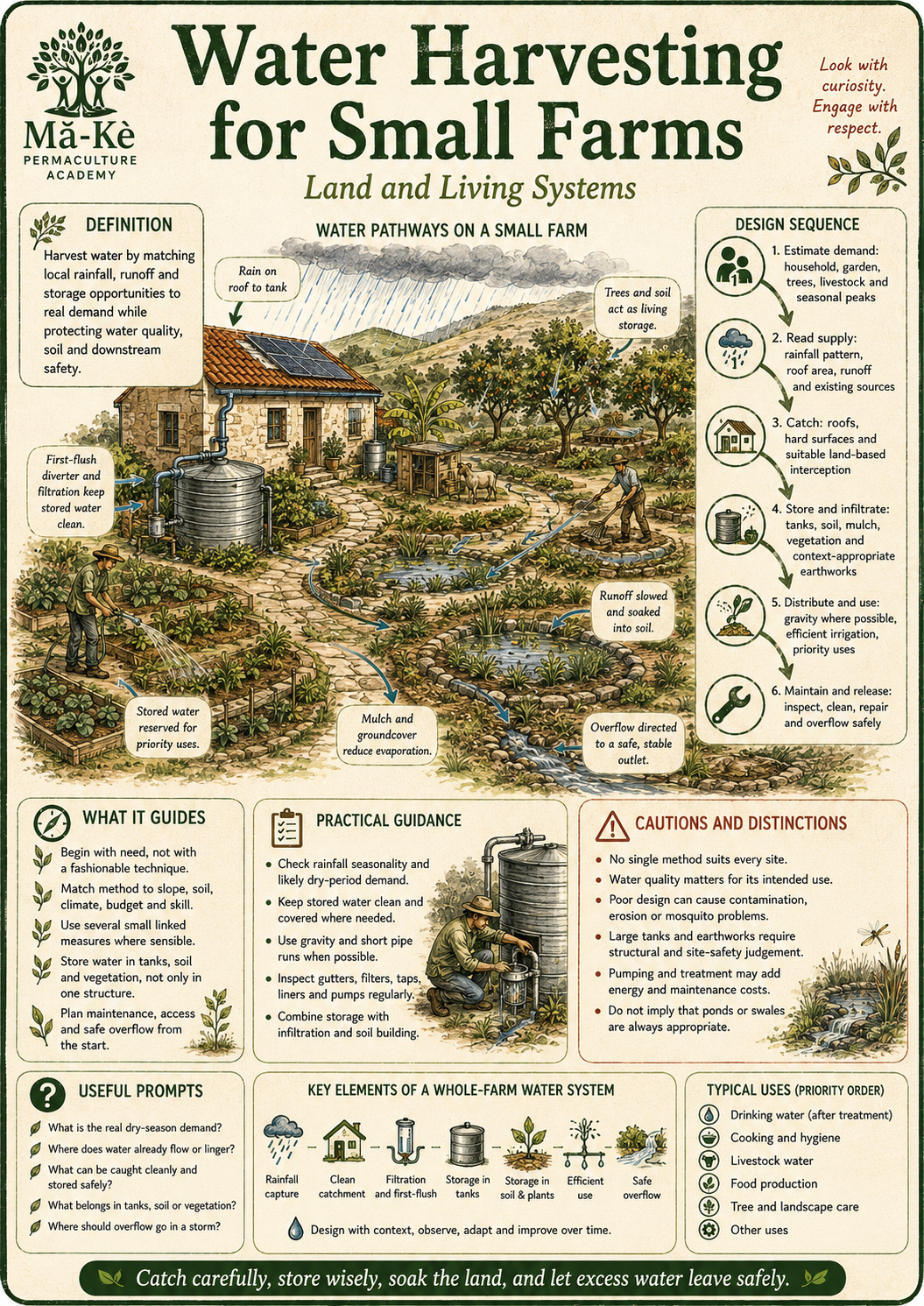
The teaching sections that follow provide the substantive HTML text equivalent of this infographic.
Build a seasonal water budget
List demands by month and intended use: drinking and food preparation, washing, livestock, nursery work, establishment watering, routine irrigation, cleaning and fire-safety reserves. Keep potable, household, irrigation and potentially contaminated flows separate unless treatment and regulation support their combination.
Use measured consumption where possible. Crop demand depends on climate, soil, rooting depth, growth stage, shade, wind and irrigation method. Record a range rather than importing one generic litres-per-acre figure. Identify which demands are essential, which can be reduced and which can stop during drought.
A minimum budget
- Monthly demand by use, including a dry-year range.
- Monthly rainfall and the length of the rainless period.
- Existing reliable supply, storage and flow rate.
- Quality required at each point of use.
- Reserve volume and the trigger for restrictions.
Estimate harvest without pretending every drop is available
For a simple roof estimate, multiply rainfall depth in millimetres by catchment area in square metres: one millimetre over one square metre is one litre. Then apply a cautious collection factor for first flush, splash, leaks, gutter capacity, filter losses and overflow. Ground catchments need more conservative, site-specific runoff assumptions because soil, slope, vegetation, compaction and storm intensity change the result.
Design 05 estimated flows from roofs, hard surfaces and a much larger surrounding catchment at Vila Pinheiro. Those figures are design-stage estimates, not measured universal coefficients. A small farm should calibrate its assumptions with rain gauges, tank-level records and observations during several storms.
Choose a connected storage portfolio
Tanks provide measurable, enclosed storage close to a roof and can protect water quality, but they require sound foundations, screened inlets, first-flush management and a safe overflow. Ponds can support irrigation, habitat and emergency water, but evaporation, seepage, embankment safety, access, mosquitoes and planning requirements may make them unsuitable. Soil and vegetation store water where plants can use it, but infiltration is not a substitute for accessible reserve water during a prolonged drought.
Distributed storage reduces dependence on one asset. A practical sequence might combine demand reduction, healthy covered soil, a modest roof tank, efficient distribution and only then larger storage justified by monitored need. Gravity can reduce pumping where elevations and pressure requirements allow it; otherwise pump energy, maintenance and backup supply belong in the budget.
Slow, spread and infiltrate with care
Contour-aligned interventions can slow runoff and encourage infiltration, but a contour line is not automatically a safe excavation line. Soil depth, permeability, slope stability, buried services, upslope catchment, access and the consequences of overtopping all matter. Swales, diversion drains and ponds are not suitable for every property.
Every component needs a defined overflow route that remains stable in a storm larger than the storage can hold. Keep concentrated water away from buildings, septic systems, unstable slopes and neighbouring land. Large earthworks, dams, stream diversions and abstraction may require professional design and regulatory permission; check the competent local authorities rather than treating this article as legal advice.
Use water efficiently and protect its quality
Prioritise soil cover, suitable crop timing, wind reduction, leak repair and irrigation scheduling before expanding supply. Drip irrigation can reduce evaporative and conveyance losses when emitters are correctly selected, filtered and checked, but blockage or poor placement can quietly deprive plants. Establishment watering for young trees differs from routine watering of mature plants.
Protect tanks from light, debris, animals and insects. Separate roof water affected by smoke, droppings or unsuitable roofing from drinking-water use unless it receives appropriate treatment and testing. Inspect pond edges and livestock access. Record pump performance, filters, leaks, mosquito controls and overflow condition before the dry season and before forecast heavy rain.
Design drought sequencing and redundancy
Agree what happens as storage falls: repair leaks, stop discretionary use, protect high-value perennial plants, consolidate annual production and reserve safe water for people and animals. Redundancy means functionally independent support, not simply owning several tanks fed by the same failed gutter or pump.
Monitor rainfall, storage level, irrigation hours, soil response and crop losses. The best next investment may be a shade structure, a pressure regulator, a larger header tank or a smaller cultivated area rather than another earthwork.
Where this material comes from
The systems sequence is an editorial synthesis of established water-harvesting practice and Mark D’Cruz’s Design 05 work. Vila Pinheiro provides a transparent example of seasonal Mediterranean rainfall, roof capture, tanks, proposed swales, pond storage, overflow and a backup well. The controlled sources distinguish calculations and proposals from measured performance; this article makes the same distinction.
Related Library resources
Sources and evidence notes
- Mark D’Cruz, Design 05 - Water Self-sufficiency, water-system design and supporting analysis.
- Mark D’Cruz, Design 05 Appendix 02 - Vila Pinheiro Water Requirements Analysis, controlled Diploma source; preliminary demand estimates requiring local recalibration.
- Mark D’Cruz, Design 03 - Vila Pinheiro: A Sustainable Homestead, whole-site survey, analysis, zoning, implementation planning and review.
- Food and Agriculture Organization of the United Nations, “Water harvesting and storage”, distinctions among soil moisture, groundwater and surface storage.
Diploma source locators
- Design 05, PDF pages 10 and 13-24: seasonal rainfall, catchments, connected components, gravity, irrigation and overflow.
- Design 05, PDF pages 35-40: staged implementation, maintenance, evaluation and cautions.
- Design 05 Appendix 02, PDF pages 1-3: household and growing-demand calculation example.
- Design 03, PDF pages 14-17: water, access, fire and whole-site sector relationships.
Planning proposals, completed activity and measured outcomes are identified separately throughout this article.