Mollison attitudinal principle · 3 of 5
Make the Least Change for the Greatest Possible Effect
Seek a proportionate leverage point while resisting the fantasy of effortless or context-free transformation.
Definition and orientation
This principle directs attention to leverage: a modest, well-placed change can alter relationships or unlock processes more effectively than extensive reconstruction. Least change is not least responsibility, lowest immediate price or smallest visible action. Effect includes durability, distribution, maintenance and unintended consequences.
Practical meaning: Define the desired effect and evidence threshold, then map causes, dependencies and possible leverage points. Prefer reversible or staged interventions where uncertainty is high. Compare whole-life cost and affected interests. Monitor whether the small intervention changes the system or merely postpones more substantial work.
Questions it can guide:
- Which relationship or constraint most shapes the outcome?
- What is the smallest responsible intervention at that point?
- Could the apparent saving create hidden work or delayed harm?
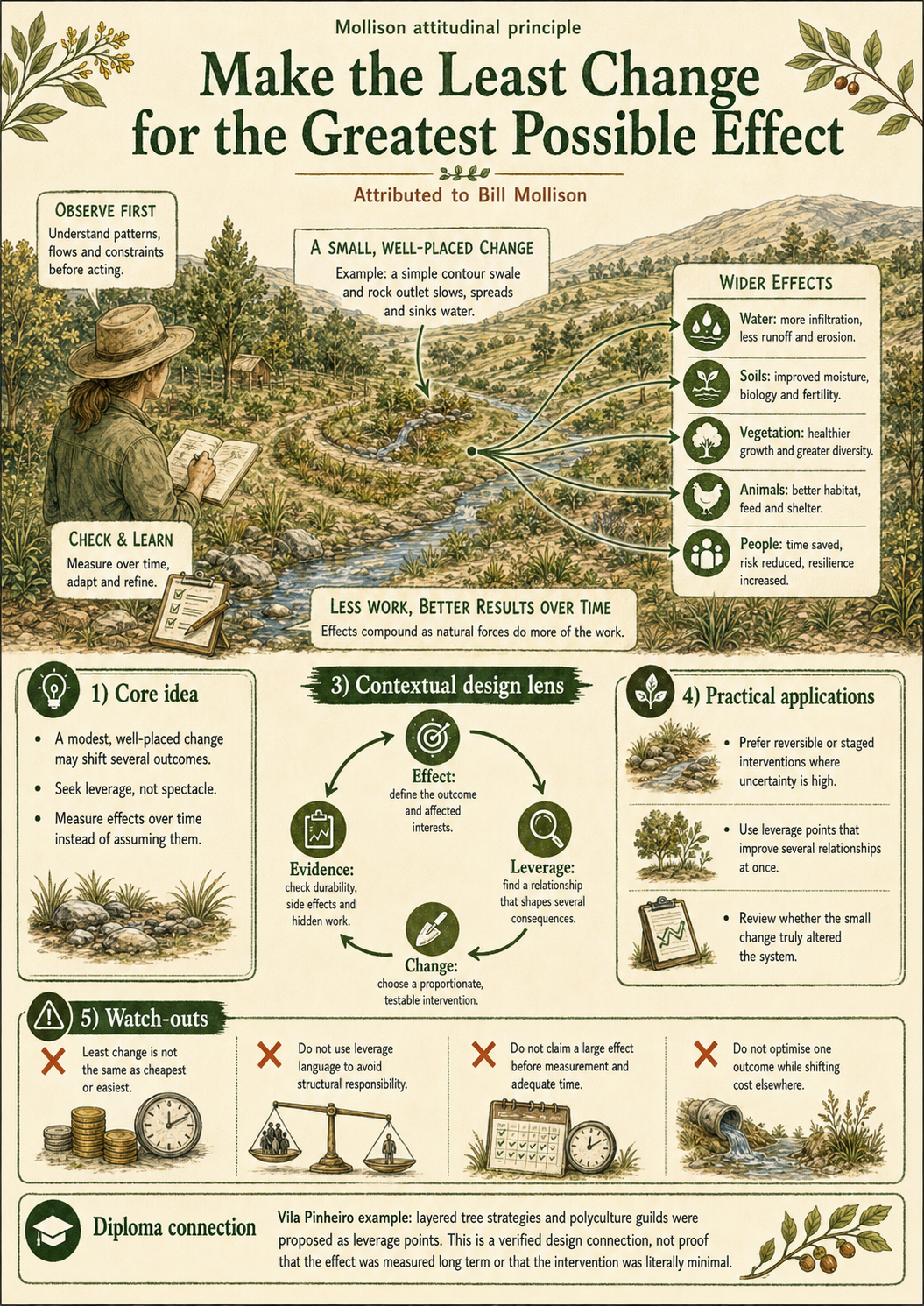
The detailed article and accessible semantic visual below provide the complete HTML text equivalent of the infographic, including its guidance, cautions, connections and evidence boundaries.
Make the Least Change for the Greatest Possible Effect: a contextual design lens
- EffectDefine the outcome and affected interests.
- LeverageFind a relationship that shapes several consequences.
- ChangeChoose a proportionate, testable intervention.
- EvidenceCheck durability, side effects and hidden work.
Origins, lineage and attribution
This page belongs to Mollison’s attitudinal principle tradition. The displayed title follows the authorised Academy catalogue; the closing acknowledgement records the nearby source wording where it differs.
Similar themes appear in David Holmgren’s twelve principles, but overlap is handled through explicit cross-links. The formulations are not represented as one list, and authorship is not transferred between traditions. The Academy paraphrases the practical meaning rather than reproducing substantial passages from the source books.
Ethical and principle context
Safe-to-Fail Experiments offers a bounded implementation method; Holmgren’s Small and Slow principle is related but not identical; SADIMET creates a place to evaluate whether leverage was real.
Use Earth Care, People Care and Fair Share to test purpose, consequence and distribution. A provocative principle can widen judgement, but it cannot certify a preferred action. Pair it with evidence, a counter-question and a named review point.
When and how to use it
- Name the decision, scale, affected people and living systems.
- Translate the principle into context-specific questions rather than repeating it as a command.
- Add a counter-question about safety, consent, urgency, maintenance or unequal effects.
- Use a suitable framework or tool to gather evidence and compare alternatives.
- Choose a proportionate action, state uncertainty and distinguish proposal from completion.
- Record what observation or feedback would trigger adaptation or stopping.
Application in Mark’s Diploma and at Vila Pinheiro
Design 08’s layered-tree strategy places polyculture guilds for management and resilience and explicitly labels that choice Least Change for Maximum Effect, a shortened register variant. The design also prioritises existing edges and cork-oak cover. This verifies intended leverage through placement and guilds, not measured long-term effect or proof that the intervention was literally minimal.
Evidence boundary: the representative connection was checked in Mark D’Cruz, Design 08: Regenerative Silviculture, controlled Diploma PDF, PDF page 21. The master register records broader use across Designs 1–10, but declaration alone is not converted into a public case result.
Limits, critiques and common misuse
- Equating least change with cheapest, easiest or least visible action.
- Using leverage language to avoid structural responsibility.
- Claiming a large effect before measurement and adequate time.
- Optimising one outcome while shifting cost elsewhere.
No principle replaces consent, law, competent technical advice, ecological assessment or accountable maintenance. Where principles pull in different directions, make the tension visible rather than selecting only the phrase that supports an existing preference.
Where this material comes from
This attitudinal principle is associated with Bill Mollison and appears in Permaculture: A Designer’s Manual (1988), where the source wording is “Make the least change for the greatest possible effect”. It belongs to a provocative design attitude intended to change how a designer frames nature, constraints, intervention, yield and agency. This page uses the authorised catalogue title “Make the Least Change for the Greatest Possible Effect”; although teaching summaries use minor wording variants, these do not make the principle part of David Holmgren’s later twelve-principle formulation. Mark D’Cruz used or recorded this principle in his Diploma register; he is not its originator, and the master register records it as LIB-052. Its lineage and wording have been checked against the named publication tradition and Permaculture Association teaching records. The representative Diploma connection is limited to PDF page 21, with proposals kept distinct from measured outcomes.
Related entries
References and provenance
- Bill Mollison, Permaculture: A Designer’s Manual, Tagari, 1988.
- Permaculture Association, “Principles from Permaculture: A Designer’s Manual by Bill Mollison”.
- Mark D’Cruz, Design 08: Regenerative Silviculture, controlled Diploma PDF, PDF page 21.
- Mă-Kè Diploma Library Master Register, Page Register LIB-052; source-matrix declarations retained separately from verified page evidence.
- Mă-Kè Permaculture Academy, “Comparing Permaculture Principle Traditions”.