Holmgren principle · 5 of 12
Use and Value Renewable Resources and Services
Prefer resources that can renew and services supplied by living systems, while respecting regeneration rates, stewardship and establishment needs.
Definition and orientation
Use and Value Renewable Resources and Services distinguishes resources renewed by natural processes from finite capital, and draws attention to non-consuming services supplied by living soil, water, plants, animals and people. Renewable does not mean limitless: use must remain within renewal, care and replacement capacity.
What it guides: the principle helps frame design judgement through questions such as:
- Which living or renewable process can meet the function with less depletion?
- At what rate and under whose care can the resource renew?
- Is a limited non-renewable input justified to establish a more durable system?
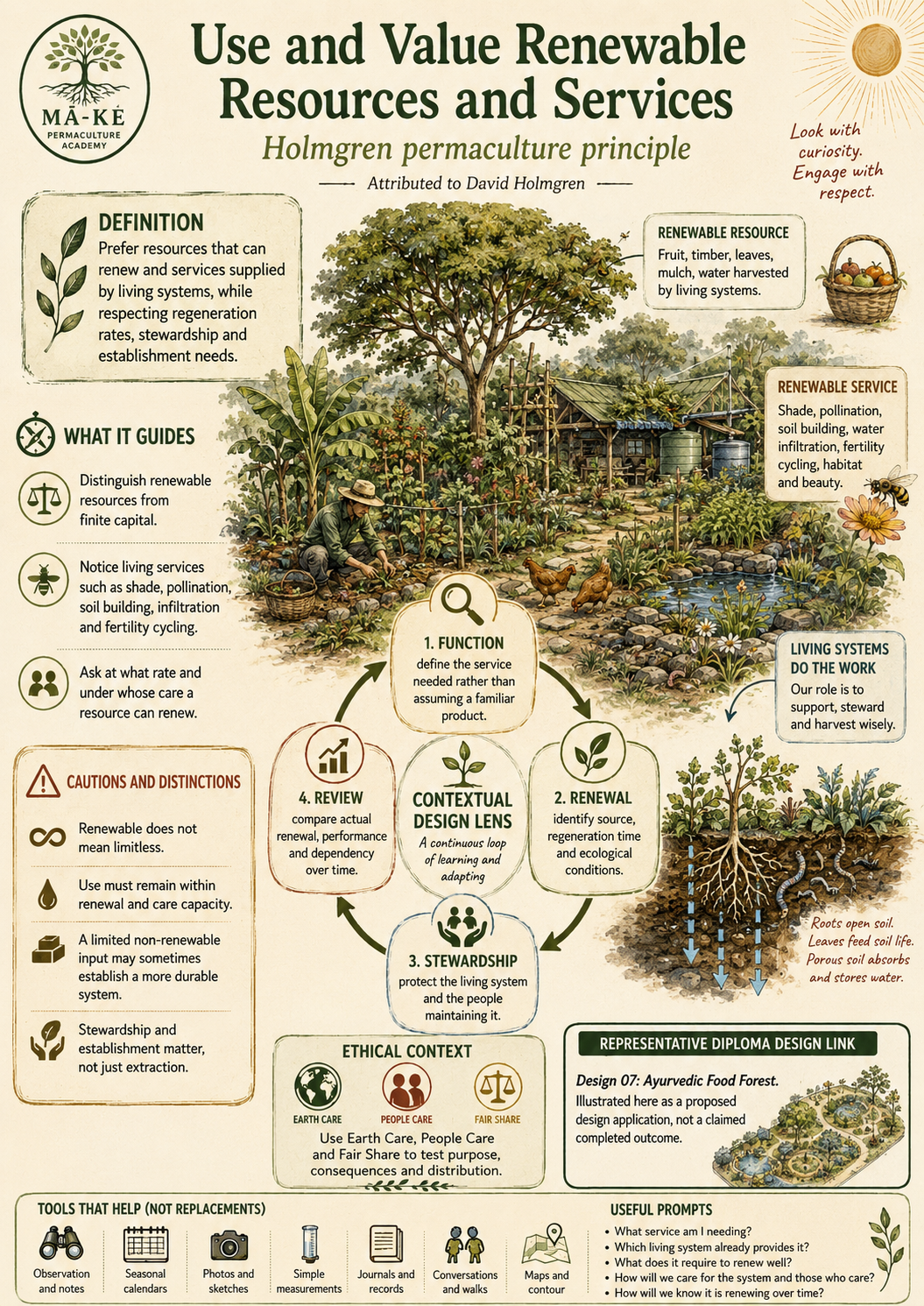
The detailed article and accessible semantic visual below provide the complete HTML text equivalent of the infographic, including its guidance, cautions, connections and evidence boundaries.
Use and Value Renewable Resources and Services: a contextual design lens
- FunctionDefine the service needed rather than assuming a familiar product.
- RenewalIdentify source, regeneration time and ecological conditions.
- StewardshipProtect the living system and the people maintaining it.
- ReviewCompare actual renewal, performance and dependency over time.
Origins, lineage and attribution
This wording belongs to David Holmgren’s twelve-principle formulation. Holmgren published the set in 2002 and describes the principles as memorable thinking tools that open different perspectives into whole-systems design. He also states that methods vary with place and situation and that principles do not substitute for practical experience or technical knowledge.
The Academy’s explanation is an attributed teaching interpretation, not a reproduction of Holmgren’s icon or a claim that Mark originated the principle. Other permaculture lineages may organise similar ideas differently.
Ethical and principle context
Catch and Store Energy can retain renewable flows; No Waste cycles resources already in the system; Diversity and Integration can support services such as shade, pollination and soil renewal. A framework helps time establishment and review, while ethics constrain overuse.
Use Earth Care, People Care and Fair Share to test purpose, consequences and distribution. Apply this principle with at least one counter-question, relevant evidence and a named review point. It should influence judgement without becoming a slogan that certifies a preferred decision.
When and how to use it
- Name the decision, scale, affected people and living systems.
- Turn the principle into one or more open questions suited to the context.
- Add a counter-question that could expose harm, urgency, maintenance or a conflicting principle.
- Use a relevant framework or tool to gather evidence; do not mistake the method for the answer.
- Choose a proportionate action and state what remains uncertain.
- Record what evidence or feedback would trigger review, adaptation or stopping.
Application in Mark’s Diploma and at Vila Pinheiro
Design 07 places keystone, native and Ayurvedic species in Zone 4 as a proposed long-term tree-restoration system, while Zone 5 hedgerows are intended to provide habitat and windbreak functions. This supports an application through living vegetation and ecosystem services. It does not verify establishment, survival, growth rates or medicinal outcomes.
Evidence boundary: this representative connection was checked in Mark D’Cruz, Design 07: Ayurvedic Food Forest, controlled Diploma PDF, PDF page 19. The master register also records broader use across Designs 1–10; those additional declarations are not converted here into unverified public case claims.
Limits, critiques and common misuse
- Assuming a biological material is renewable regardless of harvest rate or habitat damage.
- Treating ecosystem services as free while concealing stewardship labour and ecological limits.
- Rejecting every non-renewable establishment input without comparing whole-life consequences.
- Using ‘natural’ as a synonym for safe, ethical or effective.
A principle cannot replace consent, law, site-specific evidence, competent technical advice or accountable maintenance. When principles pull in different directions, make the tension visible rather than selecting only the phrase that supports an existing preference.
Where this material comes from
This page follows Principle 5 in David Holmgren’s twelve-principle formulation, published in Permaculture: Principles and Pathways Beyond Sustainability (2002). Its principal sources are Holmgren’s Essence of Permaculture and the author-led Permaculture Principles publication. Holmgren presents the twelve as connected systems-thinking and design-thinking tools whose expression varies with place and situation. Related phrases and overlapping ideas appear in other permaculture traditions, but this page neither transfers their authorship to Holmgren nor flattens their differences. Mark D’Cruz used and interpreted this principle in his Diploma work; he is not its originator, and the master register records it as LIB-032. The authoritative formulation has been checked against Holmgren’s published explanation. The representative Diploma connection is verified at PDF page 19, with proposed actions and outcomes kept explicitly distinct.
Related entries
References and provenance
- David Holmgren, Permaculture: Principles and Pathways Beyond Sustainability, 2002; revised edition, 2017.
- David Holmgren, Essence of Permaculture, revised edition, design principle 5.
- Permaculture Principles, “Principle 5: Use and Value Renewable Resources and Services”.
- Mark D’Cruz, Design 07: Ayurvedic Food Forest, controlled Diploma PDF, PDF page 19.
- Mă-Kè Diploma Library Master Register, Page Register LIB-032; source-matrix declarations retained separately from verified page evidence.
- Mă-Kè Permaculture Academy, “Principles, Patterns and Systems Thinking”, approved Cornerstone guide.