Mollison attitudinal principle · 1 of 5
Work with Nature Rather Than Against It
Assist suitable living processes instead of repeatedly suppressing them, while retaining duties of care and safety.
Definition and orientation
This attitudinal principle asks designers to understand natural forces, agencies and development before choosing intervention. Working with nature may mean using succession, gravity, decomposition, animal behaviour or seasonal timing. It does not mean that every spontaneous process is safe, desirable or beyond ethical judgement.
Practical meaning: Observe the process and identify what keeps producing the unwanted condition. Ask whether the desired function can be met by redirecting, supporting or timing an existing force. Intervene firmly where welfare, invasive species, fire, contamination or law requires it, and review whether the intervention reduces repeated conflict.
Questions it can guide:
- Which living or physical process is already active?
- Can the design assist or redirect it rather than continually oppose it?
- What harm or duty makes restraint inappropriate?
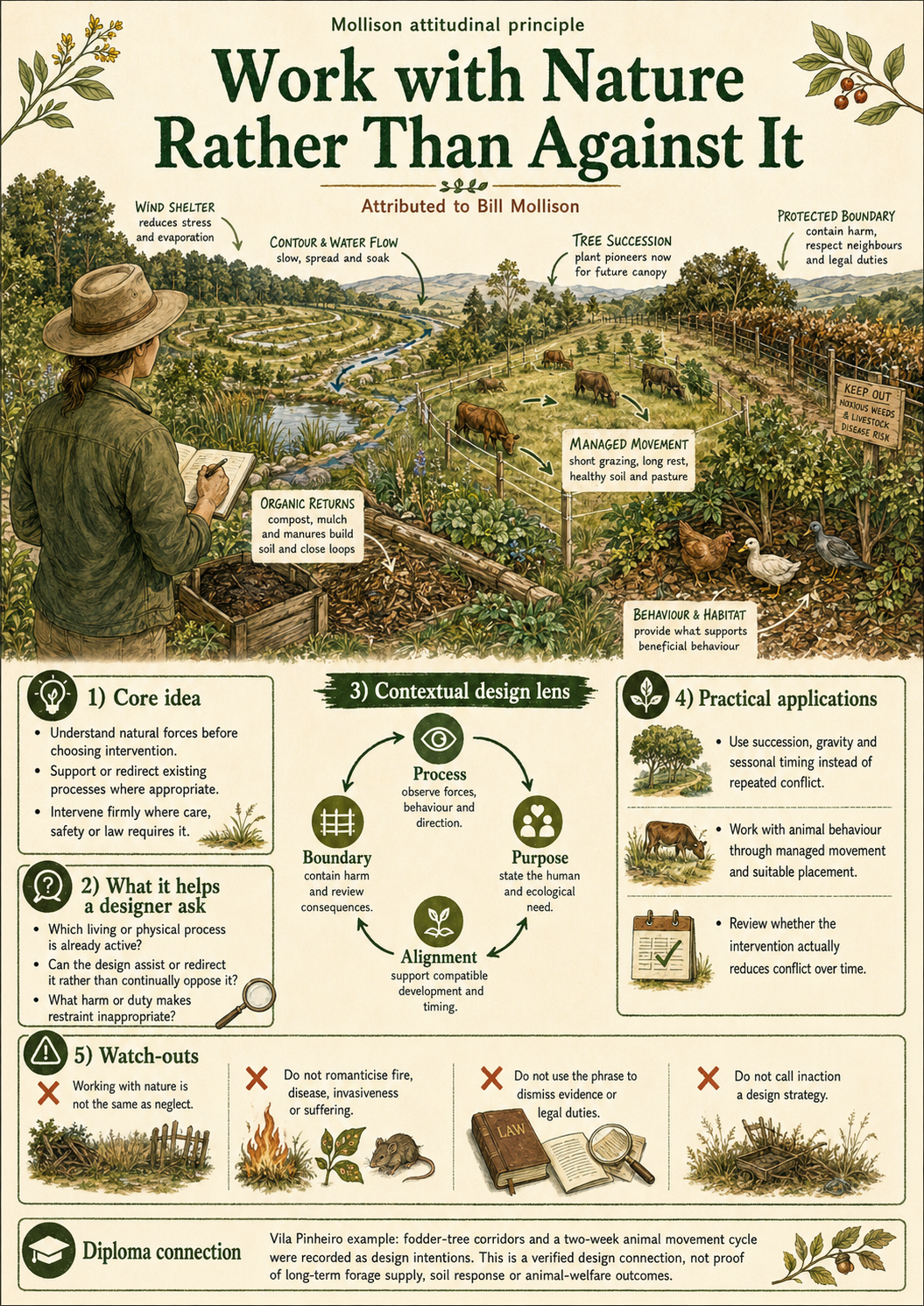
The detailed article and accessible semantic visual below provide the complete HTML text equivalent of the infographic, including its guidance, cautions, connections and evidence boundaries.
Work with Nature Rather Than Against It: a contextual design lens
- ProcessObserve forces, behaviour and direction.
- PurposeState the human and ecological need.
- AlignmentSupport compatible development and timing.
- BoundaryContain harm and review consequences.
Origins, lineage and attribution
This page belongs to Mollison’s attitudinal principle tradition. The displayed title follows the authorised Academy catalogue; the closing acknowledgement records the nearby source wording where it differs.
Similar themes appear in David Holmgren’s twelve principles, but overlap is handled through explicit cross-links. The formulations are not represented as one list, and authorship is not transferred between traditions. The Academy paraphrases the practical meaning rather than reproducing substantial passages from the source books.
Ethical and principle context
Using Biological Resources supplies an ecological design route; Accelerating Succession works with change over time; Mark’s Understanding and Respect for Nature remains a separately authored bonsai tenet.
Use Earth Care, People Care and Fair Share to test purpose, consequence and distribution. A provocative principle can widen judgement, but it cannot certify a preferred action. Pair it with evidence, a counter-question and a named review point.
When and how to use it
- Name the decision, scale, affected people and living systems.
- Translate the principle into context-specific questions rather than repeating it as a command.
- Add a counter-question about safety, consent, urgency, maintenance or unequal effects.
- Use a suitable framework or tool to gather evidence and compare alternatives.
- Choose a proportionate action, state uncertainty and distinguish proposal from completion.
- Record what observation or feedback would trigger adaptation or stopping.
Application in Mark’s Diploma and at Vila Pinheiro
Design 08 describes fodder-tree corridors and a two-week animal movement cycle and explicitly labels the corridor decision Work with Nature Rather Than Against. This records an operating paddock system and a planting intention. It does not verify long-term forage supply, soil response, stocking suitability or animal welfare.
Evidence boundary: the representative connection was checked in Mark D’Cruz, Design 08: Regenerative Silviculture, controlled Diploma PDF, PDF page 22. The master register records broader use across Designs 1–10, but declaration alone is not converted into a public case result.
Limits, critiques and common misuse
- Treating whatever happens without intervention as automatically good.
- Romanticising nature while ignoring suffering, fire, disease or invasiveness.
- Using the phrase to dismiss technical evidence or legal duties.
- Calling neglect a design strategy.
No principle replaces consent, law, competent technical advice, ecological assessment or accountable maintenance. Where principles pull in different directions, make the tension visible rather than selecting only the phrase that supports an existing preference.
Where this material comes from
This attitudinal principle is associated with Bill Mollison and appears in Permaculture: A Designer’s Manual (1988), where the source wording is “Work with nature rather than against”. It belongs to a provocative design attitude intended to change how a designer frames nature, constraints, intervention, yield and agency. This page uses the authorised catalogue title “Work with Nature Rather Than Against It”; although teaching summaries use minor wording variants, these do not make the principle part of David Holmgren’s later twelve-principle formulation. Mark D’Cruz used or recorded this principle in his Diploma register; he is not its originator, and the master register records it as LIB-050. Its lineage and wording have been checked against the named publication tradition and Permaculture Association teaching records. The representative Diploma connection is limited to PDF page 22, with proposals kept distinct from measured outcomes.
Related entries
References and provenance
- Bill Mollison, Permaculture: A Designer’s Manual, Tagari, 1988.
- Permaculture Association, “Principles from Permaculture: A Designer’s Manual by Bill Mollison”.
- Mark D’Cruz, Design 08: Regenerative Silviculture, controlled Diploma PDF, PDF page 22.
- Mă-Kè Diploma Library Master Register, Page Register LIB-050; source-matrix declarations retained separately from verified page evidence.
- Mă-Kè Permaculture Academy, “Comparing Permaculture Principle Traditions”.