Externally rooted framework · social permaculture
Regenerative Design for Changemakers
Orient learners to Abrah Dresdale’s social-permaculture approach while distinguishing it from regenerative design as a wider field and from Mark D’Cruz’s work.
Definition and orientation
Regenerative Design for Changemakers is an authored social-permaculture guide and curriculum. It applies ecological intelligence and justice-oriented practice across personal life, relationships, organisations and wider systems. The work includes a Social Design Lab, group-resilience structures and exercises for examining context, goals, patterns and change.
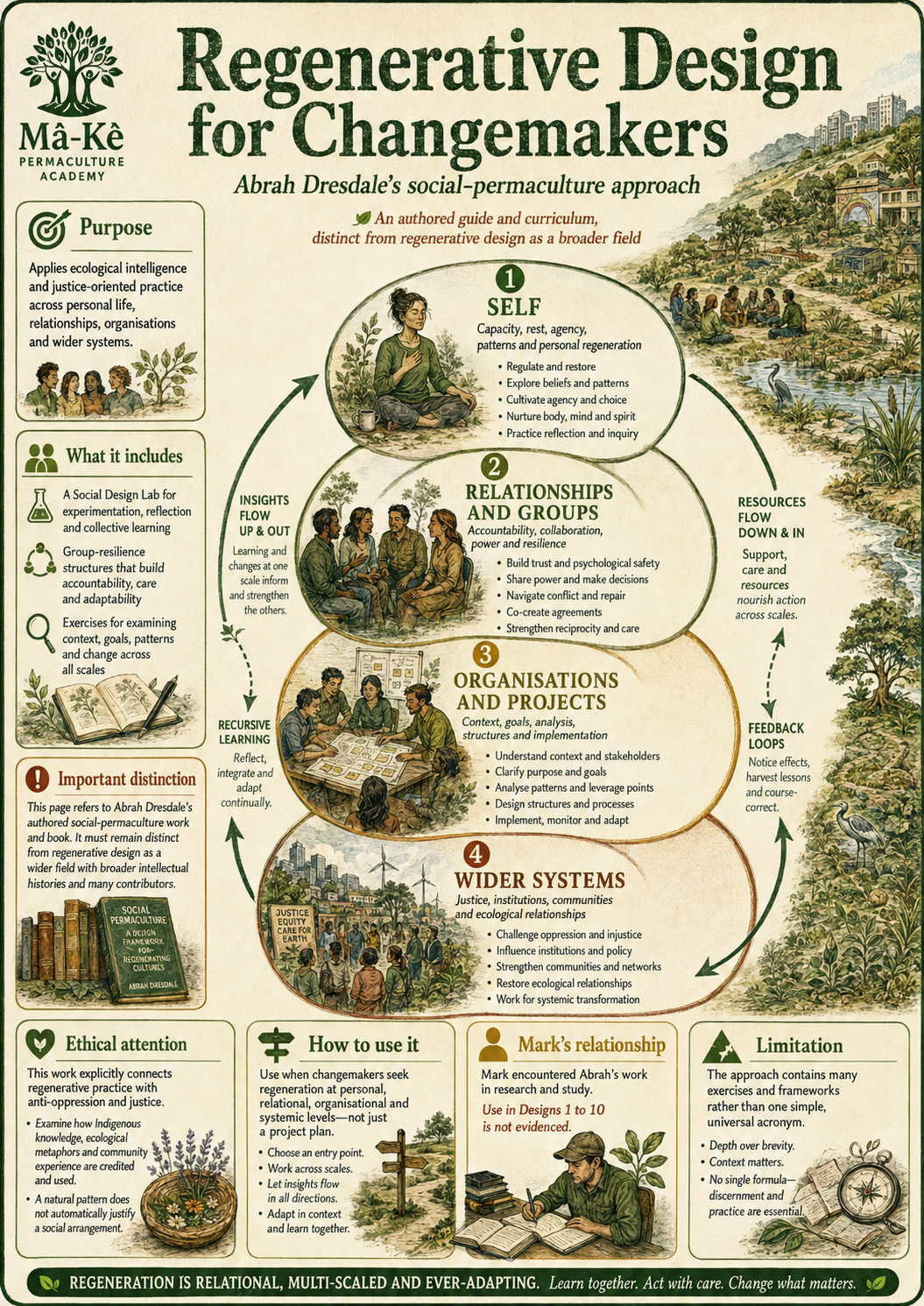
The detailed article and accessible semantic visual below provide the complete HTML text equivalent of the infographic, including its guidance, cautions, connections and evidence boundaries.
Regenerative social design across scales
Self
Capacity, rest, agency, patterns and personal regeneration.
Relationships and groups
Accountability, collaboration, power and resilience.
Organisations and projects
Context, goals, analysis, structures and implementation.
Wider systems
Justice, institutions, communities and ecological relationships.
Origins, lineage and attribution
Dresdale’s work belongs within social permaculture and regenerative change practice. Regenerative design has wider intellectual histories across architecture, living-systems thinking, ecology and community practice. Naming this page after the book prevents one author-led process from being mistaken for the whole field.
Ethical and principle context
The author explicitly connects regenerative practice with anti-oppression and justice. Learners should still examine how Indigenous knowledge, ecological metaphors and community experience are credited and used. A natural pattern does not automatically justify a social arrangement.
When and how to use it
- Clarify the scale and affected relationships.
- Examine personal and collective capacity rather than treating exhaustion as commitment.
- Map context, influence, power and regenerative or degenerative patterns.
- Develop goals and alternatives with those affected.
- Build accountability and implementation structures.
- Reflect across scales and adapt.
Application in Mark’s Diploma and at Vila Pinheiro
The master register records Abrah Dresdale’s work as encountered but not evidenced as used. This page broadens the Frameworks collection and provides a responsible route into the author’s own material. It does not retroactively label Mark’s Diploma or Academy frameworks as Dresdale adaptations.
Limits, critiques and common misuse
- The book offers a collection of frameworks and exercises, not one universally standardised sequence.
- Ecological metaphors can oversimplify power and history.
- Personal regeneration cannot substitute for structural change.
- Further critical engagement with the complete source is needed before detailed reproduction of any exercise.
Where this material comes from
This material comes from Abrah Dresdale’s social-permaculture teaching and book Regenerative Design for Changemakers. The principal sources are Dresdale’s 2021 Culture Shift Press publication and Regenerate Change’s author-led resources. The work developed in a United States social-design context combining ecological patterns, personal regeneration, organisational change and justice practice. It contains many exercises and frameworks rather than one simple acronym and must remain distinct from regenerative design as a broader field. Mark D’Cruz encountered the work in research, but the register does not evidence its application in Designs 1–10. Authorship and scope are source-supported; Diploma use is not claimed.
Related entries
References and provenance
- Abrah Dresdale, Regenerative Design for Changemakers: A Social Permaculture Guide, Culture Shift Press, 2021.
- Regenerate Change, author-led book description.
- Regenerate Change, free resources and book excerpt.
- Mă-Kè Diploma Library Master Register, LIB-009; status retained as encountered and not evidenced as used.