Externally rooted framework · coaching
GROW
Use the GROW coaching structure—Goal, Reality, Options and Will or Way Forward—while preserving its coaching lineage and limits in permaculture design.
Definition and orientation
GROW structures a developmental conversation. The person clarifies a Goal, examines present Reality, develops Options and commits to a Way Forward or Will. Its strength is disciplined questioning that supports another person’s agency rather than supplying the answer.
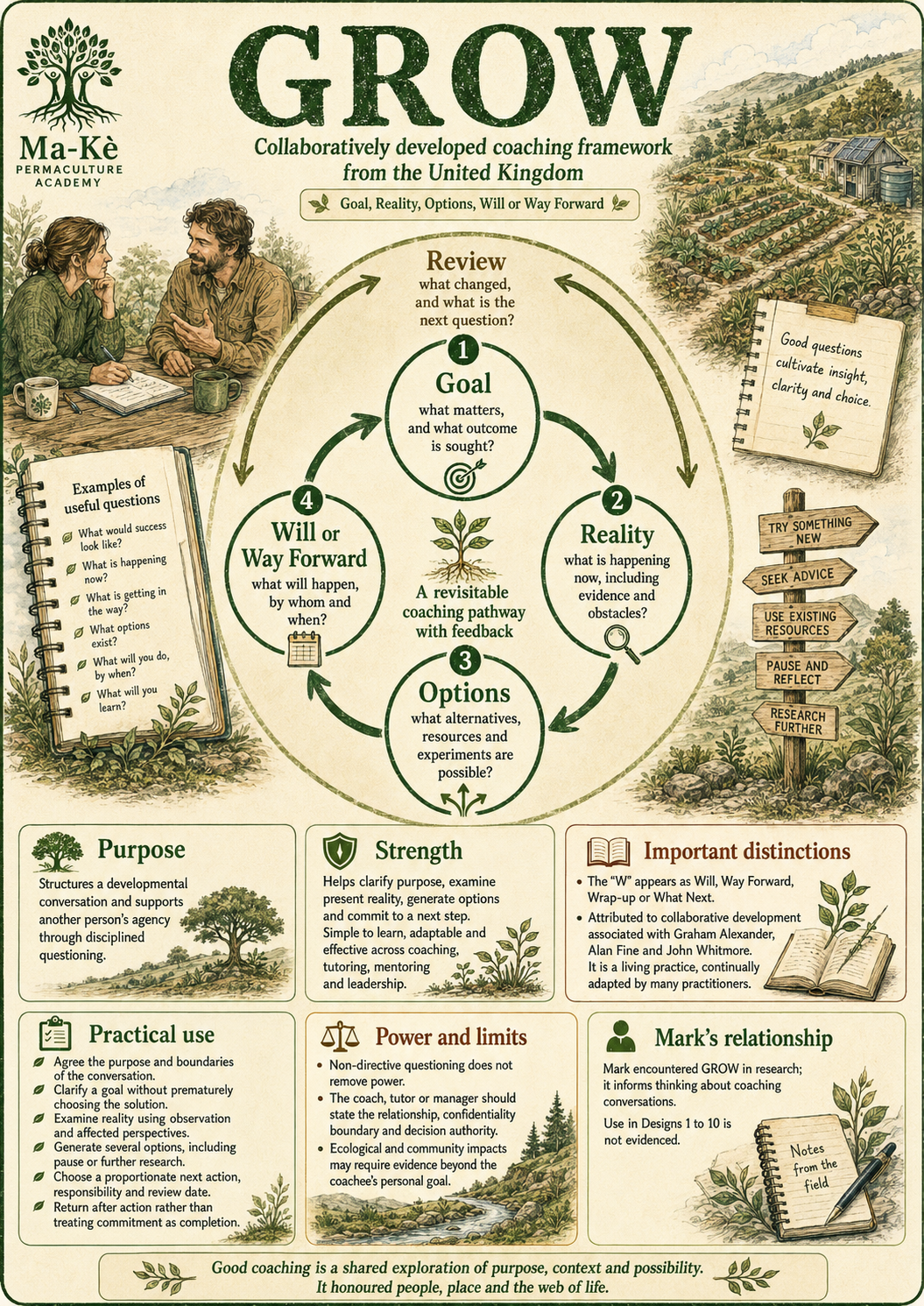
The detailed article and accessible semantic visual below provide the complete HTML text equivalent of the infographic, including its guidance, cautions, connections and evidence boundaries.
A GROW conversation with feedback
- GoalWhat matters, and what outcome is sought?
- RealityWhat is happening now, including evidence and obstacles?
- OptionsWhat alternatives, resources and experiments are possible?
- Will or Way ForwardWhat will happen, by whom and when?
- ReviewWhat changed, and what is the next question?
Origins, lineage and attribution
The model emerged through the work of several performance-coaching practitioners. Whitmore popularised it through Coaching for Performance, while accounts also credit Alexander and Fine. Later institutions use slightly different W terms while preserving the movement from purpose and reality through options to commitment.
Ethical and principle context
Non-directive questioning does not remove power. A tutor, consultant or manager should state the relationship, confidentiality boundary and decision authority. Ecological and community impacts may require evidence beyond the coachee’s personal goal.
When and how to use it
- Agree the purpose and boundaries of the conversation.
- Clarify a goal without prematurely choosing the solution.
- Examine reality using observation and affected perspectives.
- Generate several options, including pause or further research.
- Choose a proportionate next action, responsibility and review date.
- Return after action rather than treating commitment as completion.
Application in Mark’s Diploma and at Vila Pinheiro
The master register records GROW as encountered but not evidenced as used in the Diploma. It may be useful for tutorials, team reflection or clarifying a next action, but it is not presented as a replacement for site survey, ecological analysis or a complete permaculture process.
Limits, critiques and common misuse
- A clear personal goal may still be ecologically or socially unsuitable.
- Reality can be narrowed to the speaker’s perspective.
- The model can become mechanical when questions are scripted.
- It is a coaching structure, not originally a permaculture design framework.
Where this material comes from
GROW emerged from performance-coaching practice developed collaboratively in the United Kingdom during the 1980s. It is associated with Graham Alexander, Alan Fine and John Whitmore, who first published it in Coaching for Performance in 1992. The model was designed for non-directive coaching conversations rather than as a permaculture framework. Its W appears variously as Will, Way Forward, Wrap-up or What Next, and attribution should recognise collaborative development rather than a single uncomplicated origin story. Mark D’Cruz encountered GROW in research, but the register does not evidence its use in Designs 1–10. The stages and coaching lineage are supported; Diploma application is not claimed.
Related entries
References and provenance
- John Whitmore, Coaching for Performance, first edition, 1992.
- Performance Consultants International, “The GROW Model”.
- Australian Sports Commission, “The GROW Model”.
- Mă-Kè Diploma Library Master Register, LIB-010; status retained as encountered and not evidenced as used.