Externally rooted framework · organisational change
Appreciative Inquiry
Use Appreciative Inquiry’s strengths-focused change cycle without allowing appreciation to erase harm, conflict, limits or disconfirming evidence.
Definition and orientation
Appreciative Inquiry studies life-giving strengths and uses them to imagine and design change. It shifts attention from diagnosing only what is wrong towards discovering when a system works well, what makes that possible and how those conditions might inform a preferred future.
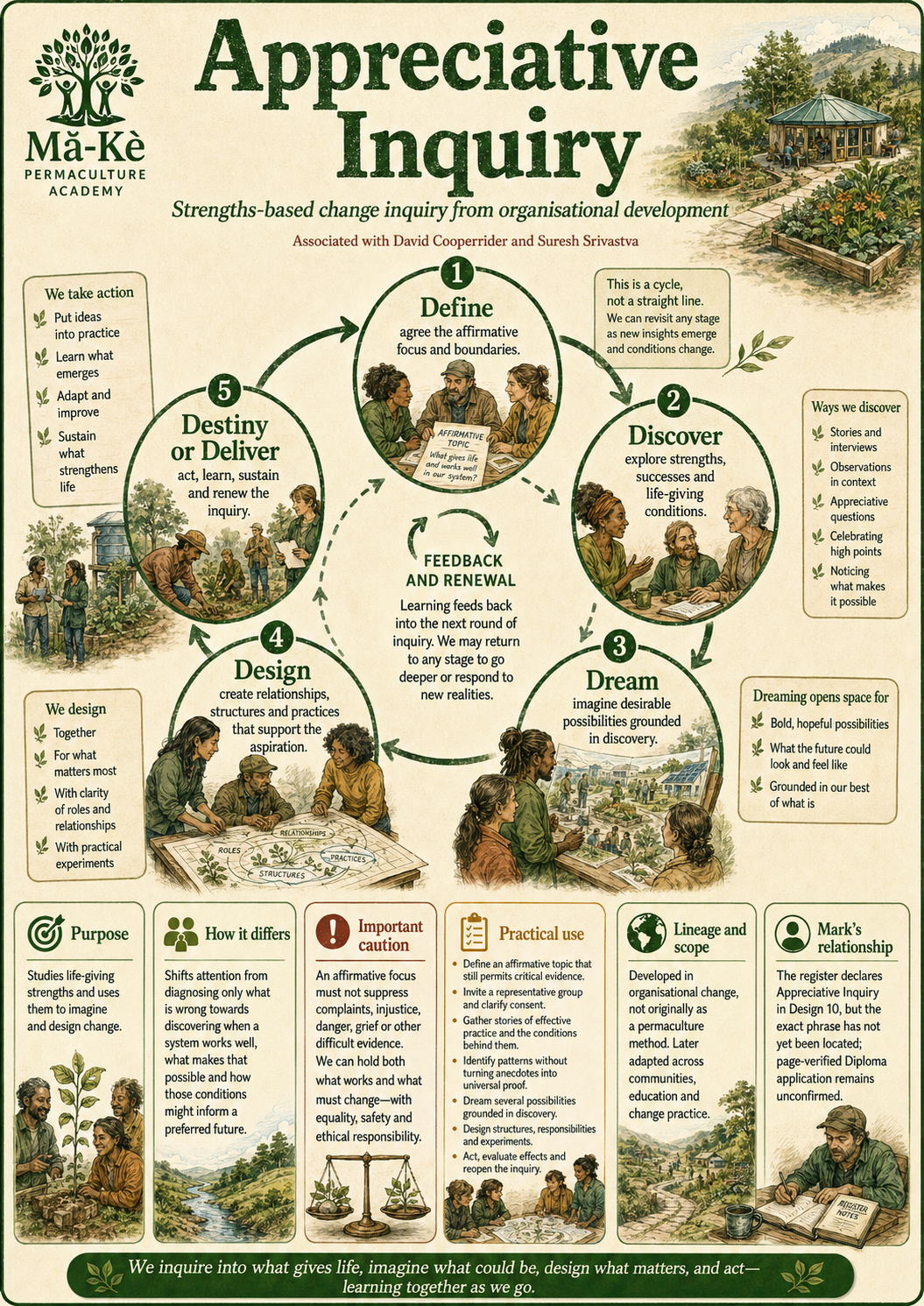
The detailed article and accessible semantic visual below provide the complete HTML text equivalent of the infographic, including its guidance, cautions, connections and evidence boundaries.
The 5-D Appreciative Inquiry cycle
- DefineAgree the affirmative focus and boundaries.
- DiscoverExplore strengths, successes and life-giving conditions.
- DreamImagine desirable possibilities grounded in discovery.
- DesignCreate relationships, structures and practices that support the aspiration.
- Destiny or DeliverAct, learn, sustain and renew the inquiry.
Origins, lineage and attribution
Cooperrider and Srivastva challenged problem-centred organisational inquiry in the 1980s. Later practice organised the approach into 4-D and 5-D cycles. The framework is not originally a permaculture method, though permaculture educators and designers use it because appreciation, participation and generative questions can support social design.
Ethical and principle context
An affirmative focus must not suppress complaints, injustice, danger or grief. Define whose strengths are being recognised, whose account may be missing and what safeguards allow difficult evidence to be heard. Appreciation becomes ethical when it expands agency without demanding positivity.
When and how to use it
- Define an affirmative topic that still permits critical evidence.
- Invite a representative group and clarify consent.
- Gather stories of effective practice and the conditions behind them.
- Identify patterns without turning anecdotes into universal proof.
- Dream several possibilities.
- Design structures, responsibilities and experiments.
- Act, evaluate effects and reopen the inquiry.
Application in Mark’s Diploma and at Vila Pinheiro
Design 10’s source matrix declares Appreciative Inquiry, but the audit did not locate the exact phrase in the supplied PDF. The page therefore connects cautiously to Mark’s use of Appreciation within the Design Web and action-learning pathway, without presenting that connection as verified use of the formal 5-D cycle.
Limits, critiques and common misuse
- Strengths language can silence harm or structural inequality.
- Success stories can be unrepresentative.
- Dreaming without implementation responsibility produces aspiration rather than design.
- The formal framework should not be inferred from ordinary use of the word “appreciation”.
Where this material comes from
Appreciative Inquiry originates in organisational-change research associated with David Cooperrider and Suresh Srivastva at Case Western Reserve University. Its principal sources are their 1987 paper and later Appreciative Inquiry scholarship. Developed first in organisational inquiry, it was subsequently adapted across communities, education and change practice. The four-stage cycle—Discover, Dream, Design and Destiny—often appears as a five-stage cycle with Define added. The Diploma register declares Appreciative Inquiry in Design 10, but the exact phrase has not yet been located; Mark D’Cruz’s action-learning work uses appreciation without claiming authorship. The framework’s lineage is supported, while the specific Diploma application remains declared rather than page-verified.
Related entries
References and provenance
- David L. Cooperrider and Suresh Srivastva, “Appreciative Inquiry in Organizational Life”, 1987.
- Appreciative Inquiry at Champlain College.
- Champlain College, introduction to the 5-D cycle.
- Mă-Kè Diploma Library Master Register, LIB-014; exact Design 10 phrase not yet located.