Externally rooted framework · Keyline
Yeomans’ Scale of Permanence
Use P. A. Yeomans’ Scale of Relative Permanence as a planning priority guide while distinguishing its Australian Keyline context from later permaculture adaptations.
Definition and orientation
The Scale of Relative Permanence helps decide planning order by considering which landscape factors are hardest to change. Yeomans’ published sequence is Climate, Land Shape, Water, Roads, Trees, Buildings, Fencing or Subdivision, and Soil. It is a priority guide, not a claim that soil matters least.
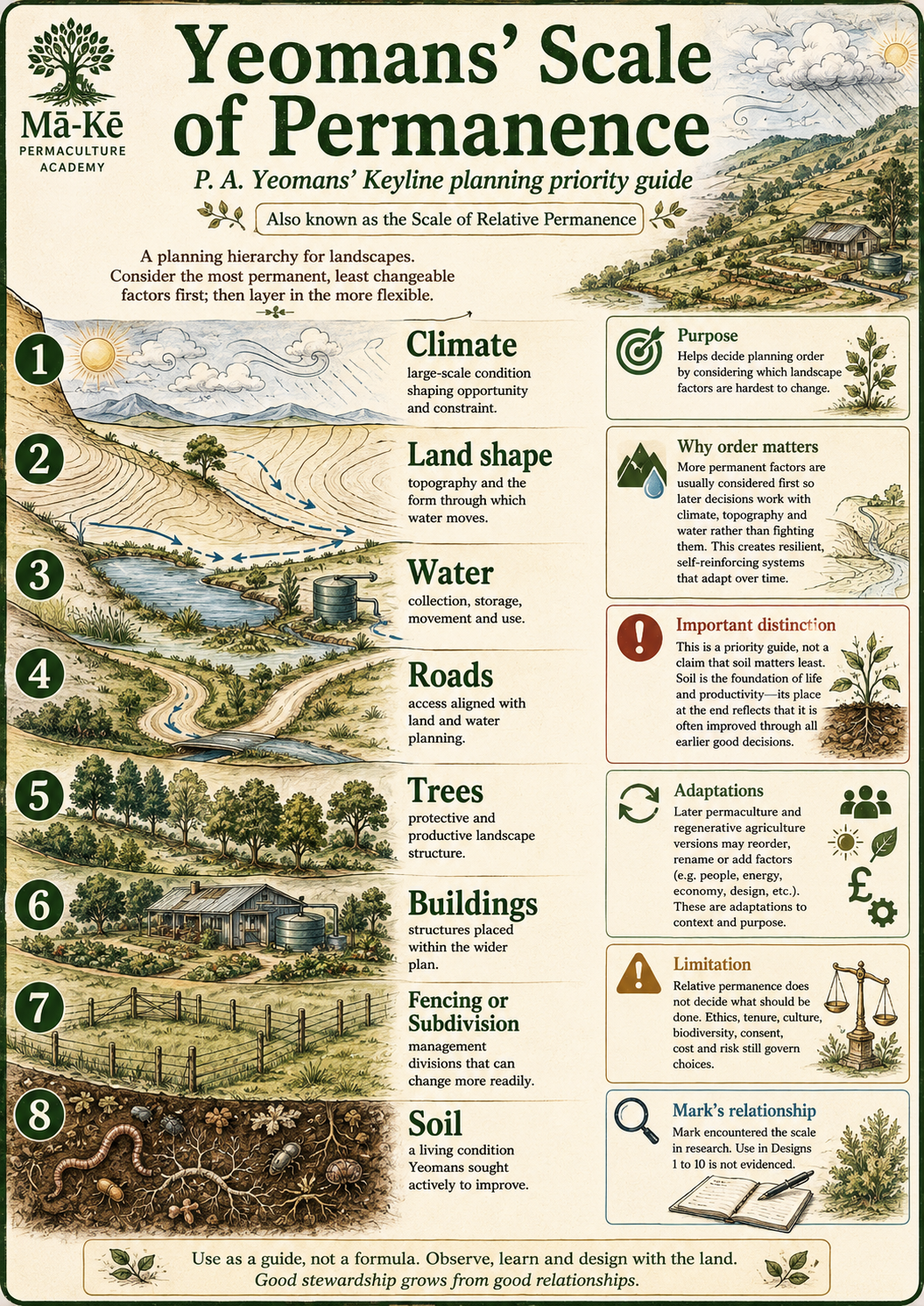
The detailed article and accessible semantic visual below provide the complete HTML text equivalent of the infographic, including its guidance, cautions, connections and evidence boundaries.
Original Keyline planning order
- ClimateLarge-scale condition shaping opportunity and constraint.
- Land shapeTopography and the form through which water moves.
- WaterCollection, storage, movement and use.
- RoadsAccess aligned with land and water planning.
- TreesProtective and productive landscape structure.
- BuildingsStructures placed within the wider plan.
- Fencing or subdivisionManagement divisions that can change more readily.
- SoilA living condition Yeomans sought actively to improve.
Origins, lineage and attribution
Yeomans published the concept in The Challenge of Landscape in 1958 after earlier Keyline work. The scale addressed priority in developing rural landscapes and was later extended to urban contexts. Permaculture adopted and adapted it because it connects climate, topography, water, access and land-use sequence.
Ethical and principle context
Relative permanence does not decide what should be done. Ethics, tenure, culture, biodiversity, consent, cost and risk still govern choices. A technically efficient water or access plan may remain socially or ecologically unacceptable.
When and how to use it
- Map climate and landform before placing infrastructure.
- Understand water movement, safe overflow and downstream effects.
- Compare access, vegetation, structures and divisions as connected systems.
- Identify which decisions close future options.
- Phase reversible trials before expensive or irreversible works.
- Review soil as a dynamic outcome and condition throughout.
Application in Mark’s Diploma and at Vila Pinheiro
The master register records Yeomans’ Scale as encountered but not evidenced as used in the Diploma. It is therefore presented as externally rooted research and a useful comparison for Vila Pinheiro—not as a framework Mark demonstrably applied. Existing Vila Pinheiro guides discuss topography, water, access, trees and phased design without retroactively labelling that work Keyline.
Limits, critiques and common misuse
- The original Australian farm context does not transfer automatically to every climate, tenure or settlement.
- Permanence is relative and can change with technology, law and disturbance.
- Later versions may be useful but should not replace Yeomans’ original order without attribution.
- Major earthworks require competent site-specific design and legal checks.
Where this material comes from
Yeomans’ Scale of Permanence originates in P. A. Yeomans’ Keyline planning system, developed in Australia. The principal sources are Yeomans’ The Challenge of Landscape (1958) and his later Keyline publications. The original scale prioritised the development of broad farm landscapes through climate, land shape, water and subsequent systems. Later permaculture and regenerative-agriculture versions reorder, rename or add factors and should be identified as adaptations. Mark D’Cruz encountered the scale in research, but the register does not evidence its use in Designs 1–10. Its origin and original order are supported; Diploma application is not claimed.
Related entries
References and provenance
- P. A. Yeomans, The Challenge of Landscape: The Development and Practice of Keyline, 1958.
- Keyline Designs, “The Australian Keyline Plan”.
- Ken B. Yeomans, Water for Every Farm: Yeomans Keyline Plan, 1993.
- Mă-Kè Diploma Library Master Register, LIB-011; status retained as encountered and not evidenced as used.