Observation and survey · Tool 2 of 12
Indicator Species Monitoring
Use selected organisms as cautious evidence about ecological conditions or change without treating one species as a proxy for the whole system.
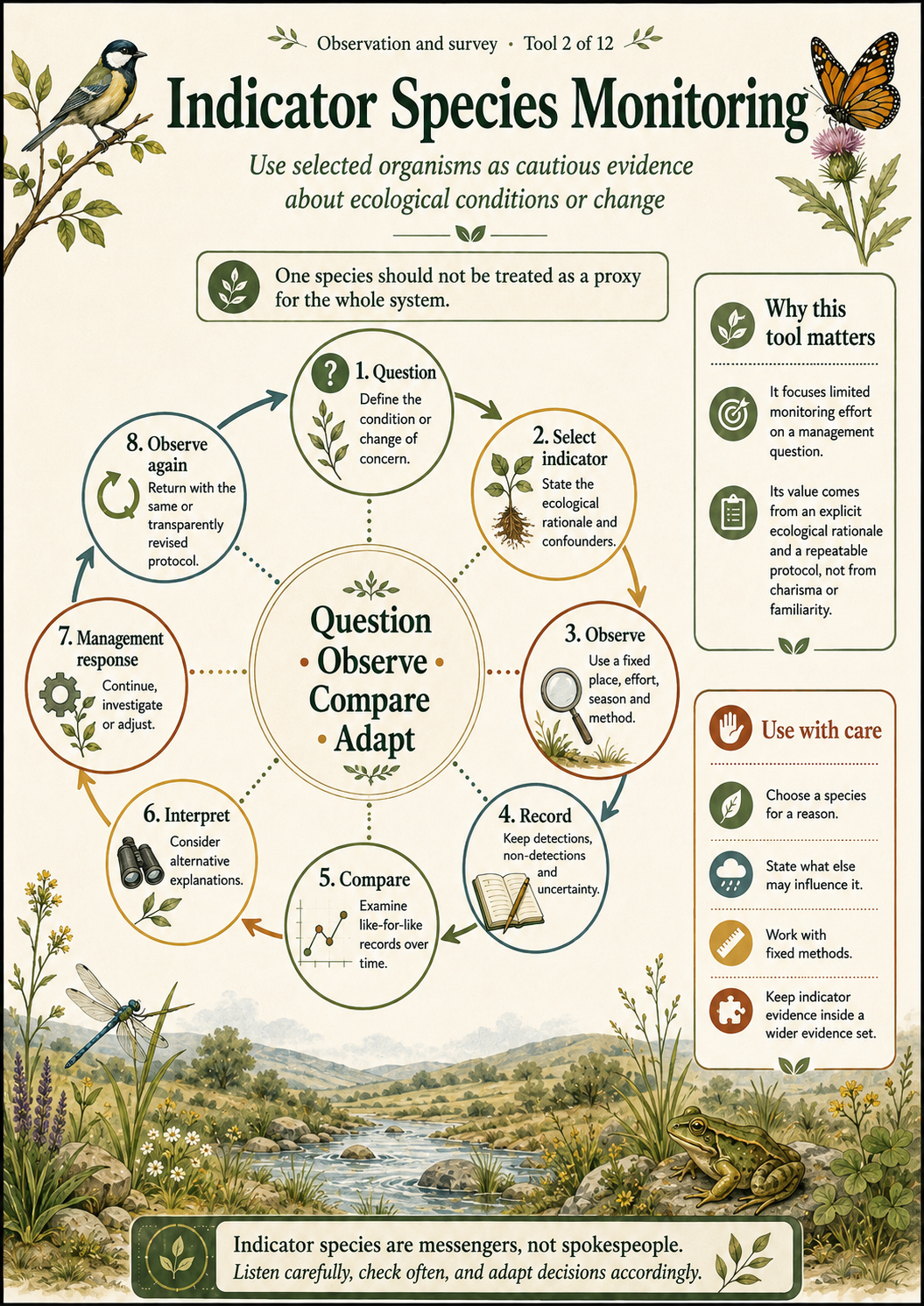
The detailed article and accessible semantic visual below provide the complete HTML text equivalent of the infographic, including its method, cautions and interpretation.
Why this tool matters
A well-chosen indicator can focus limited monitoring effort on a management question. Its value comes from an explicit ecological rationale and a repeatable protocol, not from the charisma or familiarity of the organism.
What the tool is
Indicator-species monitoring records the presence, absence, abundance, distribution, condition, behaviour or reproductive success of selected organisms that may provide evidence about a defined condition or pressure. A single indicator rarely represents the whole ecosystem, so it should sit inside a wider evidence set.
Origins and disciplinary context
Indicator species have a long history in ecology, pollution assessment and conservation monitoring. The method is not uniquely permacultural. Its responsible adaptation depends on knowing why the organism might respond, what else could influence it and how confidently it can be detected.
The tool at a glance
Iterative indicator-species cycle from management question through selection, observation, recording, comparison, interpretation and management response, returning to observation.
- QuestionDefine the condition or change of concern.
- Select indicatorState the ecological rationale and confounders.
- ObserveUse a fixed place, effort, season and method.
- RecordKeep detections, non-detections and uncertainty.
- CompareExamine like-for-like records over time.
- InterpretConsider alternative explanations.
- Management responseContinue, investigate or adjust.
- Observe againReturn with the same or transparently revised protocol.
When to use it
Use after defining a management question and establishing enough baseline knowledge to justify the indicator. It is most useful when the organism is relevant, detectable, sensitive at the right scale and practical to monitor consistently.
How to use it
- Define the management question.
- Identify a candidate species or group and explain its relevance.
- List other influences on its detection or condition.
- Fix locations, method, timing, frequency and effort.
- Record detections, non-detections and uncertainty.
- Compare over a suitable period.
- Interpret with habitat, weather and management records.
- Choose a proportionate response and observe again.
What to record
Record the question, ecological rationale, location, date, time, season, weather, method, effort, life stage, presence or count, behaviour or condition, habitat context, observer, confidence and relevant management events.
Worked example
Hypothetical Vila Pinheiro question: is habitat complexity in the managed woodland increasing? A designer might monitor a justified suite such as ground beetle groups, amphibian use of wet features and cavity-nesting activity, alongside deadwood and vegetation structure. The groups and any trend are illustrative; local expertise is needed before treating them as indicators.
Connection with Mark’s Diploma practice
Design 08 names seasonal observation logs and indicator species, giving amphibians and ground beetles as examples for tracking ecosystem health. The source records an intended monitoring approach, not verified population trends.
Diploma source locators
- Design 08, PDF page 14: indicator species, including amphibians and ground beetles, and seasonal observation logs.
- Design 08, Appendix 03, PDF page 75: seasonal observation logs and indicator species monitoring.
Interpreting the results
Ask whether a change is large, persistent and consistent with other evidence. Absence may reflect season, weather, mobility, disturbance or detectability. Correlation with an intervention does not establish causation.
Limitations
- Ecological relationships may be context-specific and non-linear.
- One indicator can miss change elsewhere in the system.
- Rare or mobile species may be impractical indicators.
- Reliable identification may require specialist competence.
Common mistakes and misuse
- Choosing an organism because it is attractive or easy to photograph.
- Changing timing or method between observations.
- Drawing conclusions from too few observations.
- Ignoring weather, habitat and management confounders.
Relationship to other Library tools
Reflection and application questions
- What precise management question does the indicator answer?
- What else could produce the same observation?
- What other indicator would reduce the risk of overgeneralising?