Externally rooted framework · CEAP
CEAP
Use CEAP to collect information, evaluate it, apply permaculture principles and plan action while keeping Mark D’Cruz’s GoCEAPER adaptation distinct.
Definition and orientation
CEAP is a compact process for situations where a substantial body of information already exists or where a lighter framework is appropriate. Its four headings prompt the designer to gather relevant material, evaluate meaning and reliability, apply permaculture principles, and plan implementation and review.
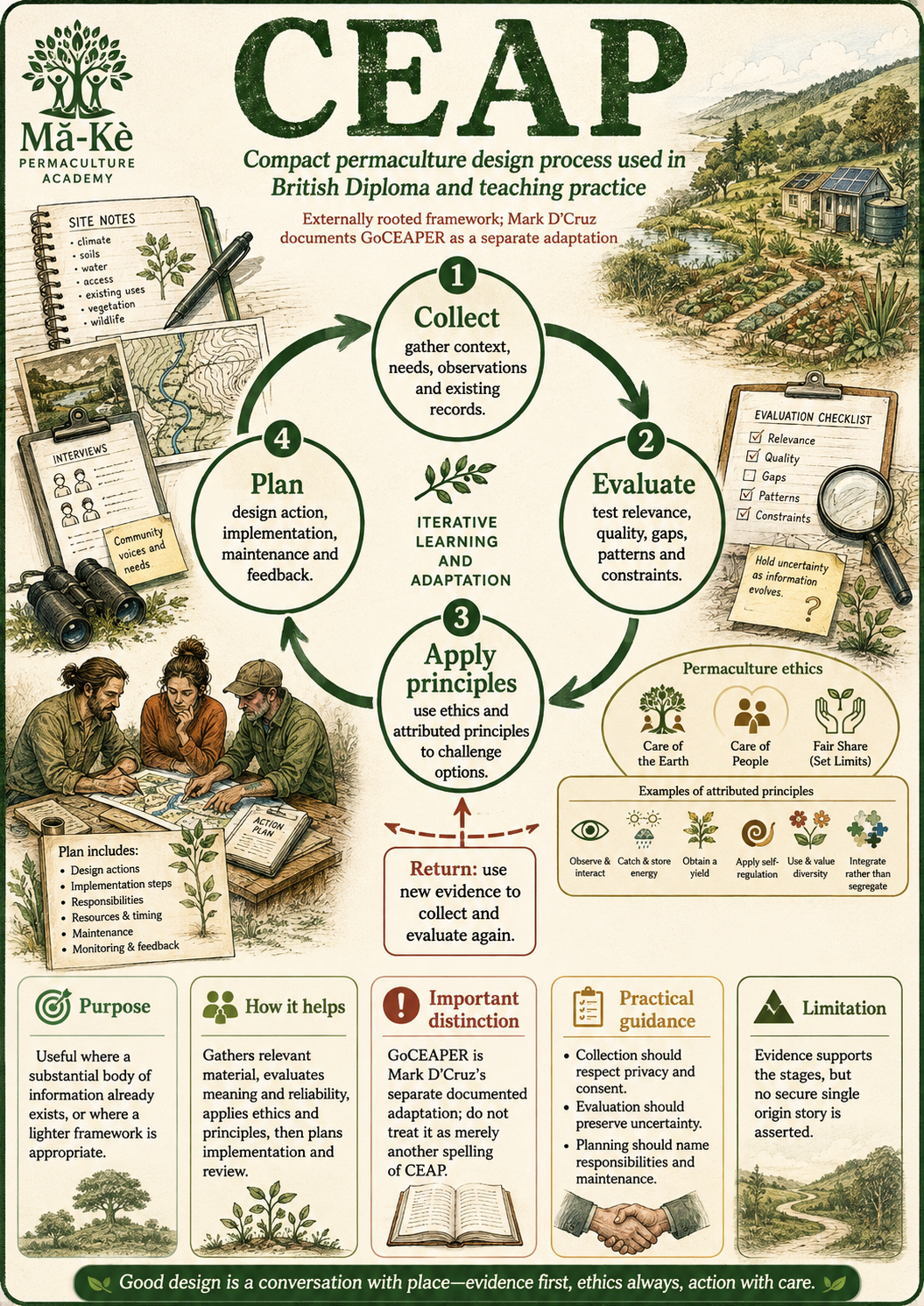
The detailed article and accessible semantic visual below provide the complete HTML text equivalent of the infographic, including its guidance, cautions, connections and evidence boundaries.
CEAP as an iterative loop
- CollectGather context, needs, observations and existing records.
- EvaluateTest relevance, quality, gaps, patterns and constraints.
- Apply principlesUse ethics and attributed principles to challenge options.
- PlanDesign action, implementation, maintenance and feedback.
- ReturnUse new evidence to collect and evaluate again.
Origins, lineage and attribution
Permaculture Association resources list CEAP among several design frameworks and document the four-stage expansion. The available evidence shows community use rather than a secure single-origin history. That uncertainty belongs in the page.
GoCEAPER must not be treated as another spelling. Mark’s version makes Goals explicit and extends evaluation and reflection for his energy self-sufficiency design.
Ethical and principle context
Applying principles should include ethics and affected interests, not merely attaching principle names to a preferred plan. Collection should respect privacy and consent; evaluation should preserve uncertainty; planning should name responsibilities and maintenance.
When and how to use it
- Define the decision and boundaries before collecting.
- Separate observation, supplied information and interpretation.
- Evaluate contradictions and missing voices.
- Use several principles and counter-questions.
- Plan alternatives, sequence, owners, resources, maintenance and feedback.
- Return when implementation produces new evidence.
Application in Mark’s Diploma and at Vila Pinheiro
The master register associates CEAP with Designs 4 and 7, but the exact phrase in Design 7 has not yet been located. Design 4 explicitly uses GoCEAPER, so this page does not claim that Mark applied unmodified CEAP there. The existing GoCEAPER page remains the authoritative treatment of Mark’s adaptation.
Limits, critiques and common misuse
- The compact headings can hide weak design generation or participation.
- “Plan” must not become a container for every unexamined later responsibility.
- The available source record does not support a confident single-origin claim.
- Do not count a declared matrix tick as page-level evidence of use.
Where this material comes from
CEAP is a compact permaculture design process circulating in British Diploma and teaching practice. Its principal source base is Permaculture Association teaching material and documented practitioner use; no single originator is asserted here. CEAP is commonly expanded as Collect, Evaluate, Apply permaculture principles and Plan, while later descriptions may include implementation, maintenance and feedback within Plan. GoCEAPER remains Mark D’Cruz’s separate documented adaptation: Mark encountered CEAP and adapted it for Design 04, but does not claim to have originated CEAP. The stages are supported, while sole authorship remains unverified and is not claimed.
Related entries
References and provenance
- Permaculture Association, “Design Methods”.
- Permaculture Association, “Extending a Forest Garden”, documenting Collect, Evaluate, Apply and Plan with implementation, maintenance and feedback.
- Mă-Kè Diploma Library Master Register, LIB-004 and Source Gap GoCEAPER.
- Mark D’Cruz, Design 04: Energy Self-Sufficiency and the existing GoCEAPER framework page.