Quantitative and decision tools · Tool 12 of 12
Decision Matrix and Multi-Criteria Comparison
Compare viable alternatives against explicit criteria while keeping evidence, judgement, trade-offs and sensitivity visible.
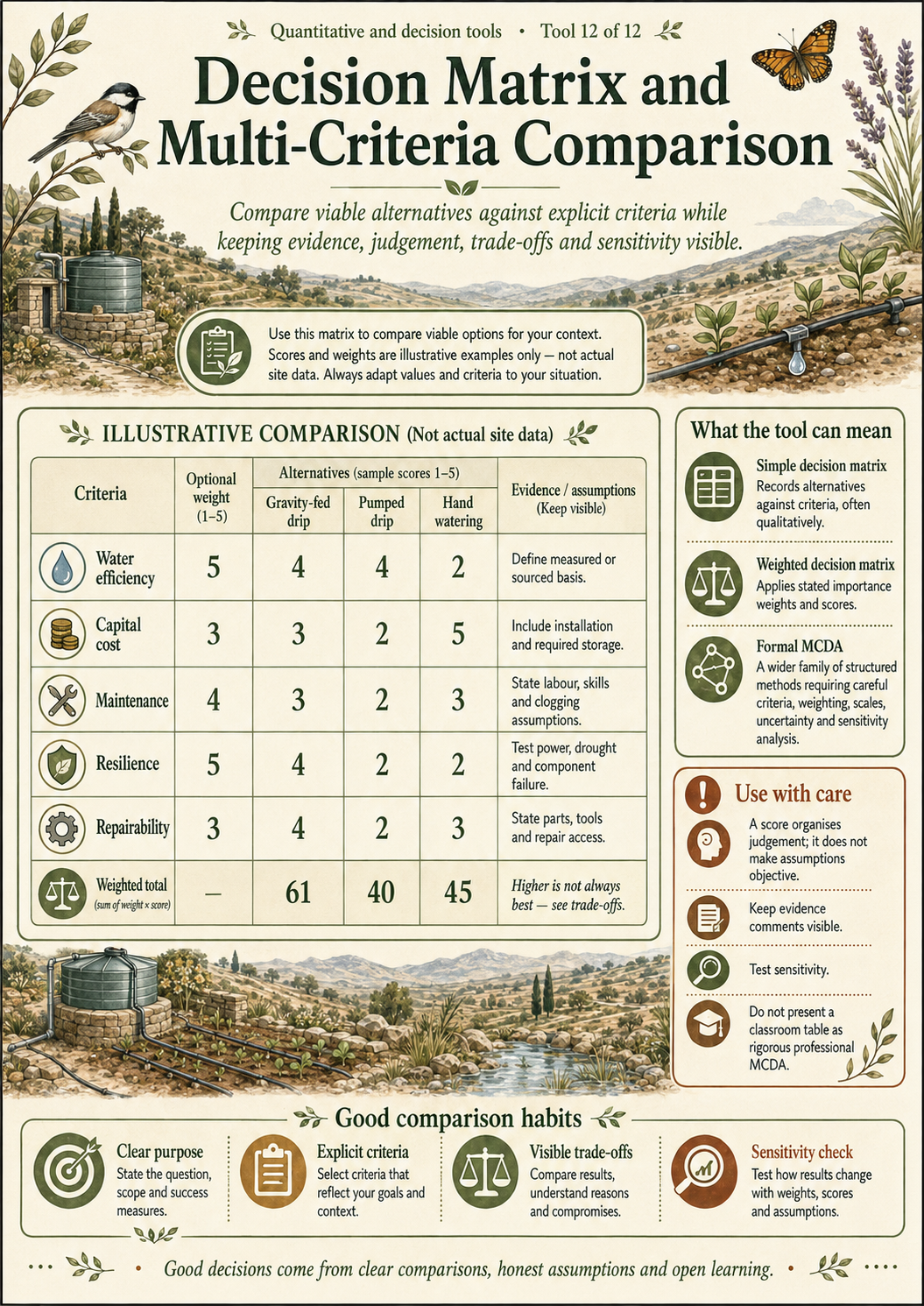
The detailed article and accessible semantic visual below provide the complete HTML text equivalent of the infographic, including its method, cautions and interpretation.
Why this tool matters
When several options could meet the purpose, an explicit matrix can expose why one appears preferable and where the choice is fragile. A score organises judgement; it does not make subjective assumptions objective.
What the tool is
- Simple decision matrix
- Records alternatives against criteria, often qualitatively.
- Weighted decision matrix
- Applies stated importance weights and scores.
- Formal MCDA
- A structured family of methods requiring careful decision context, criteria, scales, weighting, uncertainty and sensitivity analysis.
A classroom scoring table can teach comparison, but should not be described as rigorous professional MCDA.
Origins and disciplinary context
Decision matrices and multi-criteria analysis come from operations research, policy appraisal, engineering and decision science. Permaculture designers can use a proportionate version when ecological, social, practical and financial criteria need to be considered together.
The tool at a glance
Illustrative decision matrix comparing gravity-fed drip, pumped drip and hand watering against water efficiency, capital cost, maintenance, resilience and repairability, with optional weights, evidence comments and a sensitivity note.
| Criterion | Optional weight | Gravity-fed drip | Pumped drip | Hand watering | Evidence / comment |
|---|---|---|---|---|---|
| Water efficiency | 5 | 4 | 4 | 2 | Define measured or sourced basis. |
| Capital cost | 3 | 3 | 2 | 5 | Include installation and required storage. |
| Maintenance | 4 | 3 | 2 | 3 | State labour, skills and clogging assumptions. |
| Resilience | 5 | 4 | 2 | 2 | Test power, drought and component failure. |
| Repairability | 3 | 4 | 3 | 5 | Record local parts and competence. |
When to use it
Use when the decision is defined, alternatives are viable and several explicit criteria matter. Begin qualitatively where evidence is weak; add weighting only when its meaning can be justified.
How to use it
- Define the decision, boundary and decision-makers.
- Identify viable alternatives, including doing less or delaying where appropriate.
- Define independent, non-duplicative criteria.
- State evidence and a scale for each criterion.
- Compare performance before applying weights.
- Apply weights only where justified and record whose values they represent.
- Examine trade-offs, thresholds and non-compensable duties.
- Test sensitivity to scores, criteria and weights.
- Record judgement and review when assumptions change.
What to record
Record decision context, alternatives, criteria, units or scales, evidence, uncertainty, weights and rationale, scores and author, thresholds, trade-offs, sensitivity tests, excluded options, decision, dissent and review trigger.
Worked example
The visual compares three illustrative irrigation strategies against water efficiency, capital cost, maintenance, resilience and repairability. Before summing, the designer should test whether a low resilience score can be compensated by low cost, whether criteria overlap and whether a small weight change reverses the result.
Connection with Mark’s Diploma practice
No formal Decision Matrix application was located in the controlled Design 03, 05 or 08 source PDFs. The worked example is therefore a reconstruction. Mark demonstrably used other decision prompts represented in the Library, including SWOC, Six Thinking Hats and PMI; those methods are compared rather than relabelled.
Diploma source locators
- Design 03, PDF pages 19 to 20: SWOC application, cited as related decision practice rather than a decision matrix.
- Design 05, PDF page 3: PMI named among tools, but no formal decision matrix located.
- Design 08, PDF page 32: Six Thinking Hats evaluation, not a decision matrix.
Interpreting the results
Inspect the evidence behind each cell before the total. Identify criteria that dominate, thresholds that should not be traded away and alternatives that perform differently under plausible assumptions. A near tie may call for more evidence or a small reversible trial.
Limitations
- Scores compress uncertainty and qualitative difference.
- Weights embed values and power.
- Double-counted criteria distort totals.
- Compensatory scoring may conceal an unacceptable failure.
Common mistakes and misuse
- Defining criteria to favour a preferred option.
- Scoring without evidence or a common scale.
- Presenting arithmetic as objectivity.
- Omitting sensitivity analysis and dissent.
Relationship to other Library tools
Reflection and application questions
- Which scores are measurements and which are judgements?
- What result changes when a weight moves modestly?
- Which duty or threshold must not be compensated by a high total elsewhere?